January 2026

How a Wellness Coach Can Help You Achieve Lasting Change

Transform Your Life with a Singapore Wellness Coach

Transform Your Life with a Singapore Wellness Coach

It’s easy to promise yourself a reset: earlier nights, calmer days, better food, more movement. It’s harder to keep those promises when work expands into evenings, family needs fluctuate, and screens nudge you to stay “on” a little longer. The result is familiar: short bursts of effort followed by a slide back to old patterns.

Sustainable change requires something deeper than another plan. It needs a coach who can help you examine your stories about success and rest, your emotional patterns under pressure, and the physical habits your body falls into when life gets loud. When those layers shift together, behaviour changes feel natural—not forced.

What a Whole-Person Coach Actually Does

A capable coach looks beyond food logs and fitness targets. They work across three tightly connected domains:

  • Language and interpretation — the way you explain events to yourself (“If I stop at 7 pm, I’m falling behind”).

  • Emotions and mood — the feeling states that expand or shrink your options (calm, urgency, worry, frustration).

  • Body and presence — breath, posture, and micro-tensions that reveal whether your nervous system is braced or grounded.

By noticing these in real situations—late-night emails, hectic mornings, difficult conversations—you learn to choose responses instead of reacting automatically. Over time, that creates a new “default” you can rely on.

The First Step: Clarity You Can Use

Most people already know what they “should” do. The gap is clarity about what matters most right now and what gets in the way. Early coaching sessions typically centre on:

  • Defining outcomes that feel alive (not just numbers on a tracker).

  • Locating friction points (decision fatigue, social pressure, poor sleep architecture, unhelpful self-talk).

  • Designing tiny experiments that suit your real life, not an idealised routine.

You don’t need a wholesale life overhaul. You need one change that works on Tuesday afternoon, after three meetings, with dinner to cook.

Design Principles That Make Change Stick

Design Principles That Make Change Stick

1) Energy Before Time

You can’t schedule willpower. Together, you’ll map your attention across the day and place deep work, exercise, or recovery where your energy naturally supports them.

2) Friction Down, Reward Up

Tiny adjustments—laying out shoes, a five-minute “shutdown” ritual, a water bottle on the desk—reduce the activation energy for good choices and make them more rewarding.

3) Micro-recovery, Macro-consistency

Short resets (a breathing protocol, a stretch sequence, a ten-minute walk) prevent the all-too-familiar crash-and-binge cycle at week’s end.

4) Behaviour You Can See

Vague aims (“be healthy”, “stress less”) become observable actions: lights out by 11 pm, a phone-free lunch, and three strength sets after work on Monday and Thursday.

5) Review Without Drama

Each week, you’ll ask: What worked? What got in the way? What is the smallest tweak that would make next week easier? Progress beats perfection every time.

How Coaching Meets Real-World Constraints

How Coaching Meets Real-World Constraints

Change doesn’t happen in a vacuum. A thoughtful coach will help you translate intention into practice within the constraints of dense schedules, shared spaces, caregiving, and cultural expectations.

  • Calendars become allies: protected focus blocks, predictable meal slots, and hard edges on the day.

  • Communication reduces overload: clearer requests at home and work, realistic promises, and fewer obligations by default.

  • Environment shapes behaviour: pre-set grocery lists, simplified meal rotations, standing desk options, and deliberate device settings.

When the system supports your goal, you need less discipline to keep going.

What a Typical Coaching Journey Can Look Like

What a Typical Coaching Journey Can Look Like

1) Discovery

You’ll define what “well” means for you—more energy, steadier mood, fitter body, clearer mind—and why it matters now. This phase often includes gentle tracking (sleep, steps, screen use) to ground decisions in reality.

2) Foundations

Together you’ll establish non-negotiables: a nightly wind-down, a weekly planning ritual, one meaningful workout, one social reset. These serve as anchors when weeks get messy.

3) Iteration

Expect experiments and adjustments. If evening exercise keeps slipping, you’ll try morning movement. If late-night messages pull you back to work, you’ll test delayed send or notification filters.

4) Expansion

Once anchors settle, you can add aims—improved strength, more time outdoors, or targeted nutrition—without destabilising what already works.

5) Maintenance

You’ll shift into lighter touch support: monthly tune-ups, seasonal resets, or a short booster when life changes (a new role, travel, school holidays).

Coaching Tools That Make a Difference

  • Implementation intentions: “After I close the laptop, I fill my water, set clothes for tomorrow, and write the first task on a sticky note.”

  • If-then planning: “If a meeting overruns, I’ll take a three-minute walk before opening email.”

  • Boundaries with language: “I can deliver A on Thursday or B next Monday—what’s the priority?”

  • Somatic cues: feet grounded, jaw soft, longer exhale—especially before feedback, negotiations, or end-of-day decisions.

  • Reflection prompts: “What helped me keep my promise this week?” (Not: “Why did I fail?”)

These are simple on purpose. Simple wins on busy days.

Choosing a Coach You’ll Trust (and Keep Seeing)

1) Method over marketing. Ask how they work across language, mood, and body—not only diet and gym plans. Change that lasts is multi-layered.

2) Practice and feedback. Look for someone who builds weekly experiments with you and reviews results without shaming.

3) Boundaries and ethics. Coaching is not therapy. A professional knows when to refer, how to keep information confidential, and what consent really means.

4) Fit. Do you feel heard? Do sessions end with specific actions you’re confident you can try this week? Chemistry matters.

If you want a coach trained to work at the level of “way of being”, explore programmes that include ontological coach training—they emphasise presence, interpretation, and embodiment alongside practical tools.

What Changes When You Commit

  • Clearer thinking. With fewer open loops and a steadier nervous system, decisions get easier.

  • More energy. Sleep quality improves; movement becomes a regular part of life, not a negotiation.

  • Stronger relationships. Better boundaries at work and home reduce resentment and guesswork.

  • Quicker resets. Bad days don’t spiral into bad weeks; you know how to recover.

None of this depends on perfect discipline. It depends on better design and consistent support.

Frequently Asked (Real) Questions

“What if my job is simply too demanding?”
Then we design for that reality. We’ll place recovery exactly where it fits, reduce low-value commitments, and protect the few moves that make the biggest difference.

“What if I fall off the plan?”
You will. Everyone does. Coaching assumes fluctuation and builds fast re-entry: one anchor action today, not a complete restart tomorrow.

“How soon will I see results?”
Most people notice earlier nights, calmer mornings, or steadier focus within two to three weeks. Fitness and body composition changes typically follow as the routine holds.

For Leaders: Modelling Sustainable Performance

If you manage others, your habits set the tone. Consider these shifts:

  • Delay-send messages outside core hours; write them when you like, but let them land when others work.

  • Publicly trade off priorities: “To add this project, we’ll pause X until the 15th.”

  • Run shorter, sharper meetings with clear decisions and fewer attendees.

  • Praise smart pacing as much as late heroics.

Teams copy what leaders celebrate. Choose the behaviours you want reflected.

The Role of Credentials

Credentials don’t coach people—people coach people—but they do signal grounding. If you’re comparing options, programmes that include coaching certification that trains practitioners to work safely and effectively across language, emotion, and body, with strong attention to ethics and cultural sensitivity.

Final Thoughts: Small Wins, Repeated

Lasting change rarely arrives with a dramatic overhaul. It accumulates through small, well-designed actions repeated in the life you actually live. A capable coach helps you decide which actions matter, where they fit, and how to come back to them when you slip.

Start with one anchor tonight—write tomorrow’s first task, set the lights out, and put your phone to charge outside the bedroom. Tomorrow, take one ten-minute walk. The day after, protect one focus block. That’s how momentum begins: not with a grand gesture, but with a better week than the last.

How a Wellness Coach Can Help You Achieve Lasting Change Read More »

How Executive Coaching Strengthens Leadership Effectiveness at the Senior Level

How Executive Coaching Strengthens Leadership Effectiveness at the Senior Level

The Role of Executive Coaching in Senior Leadership

Senior leadership today involves navigating complexity, uncertainty, and constant change. Beyond experience and technical expertise, senior leaders are expected to influence at scale, make high-stakes decisions, and shape organisational culture.

Executive coaching has emerged as a strategic development approach that supports leaders in meeting these demands. Rather than offering generic advice, it provides a structured, confidential space for reflection, challenge, and sustained leadership growth.

Defining Leadership Effectiveness at the Senior Level

Leadership effectiveness at the senior level goes beyond delivering short-term results. It reflects how well a leader sets direction, enables others, and sustains performance over time.

Senior leaders are responsible for strategic clarity, organisational alignment, and long-term value creation. Their behaviour influences culture, trust, and decision quality across the organisation.

Unlike operational leadership, senior leadership requires systemic thinking. Leaders must balance competing priorities, manage uncertainty, and consider the broader impact of every decision.

How Executive Coaching Strengthens Senior Leadership

How Executive Coaching Strengthens Senior Leadership

Enhancing Self-Awareness and Emotional Intelligence

At senior levels, self-awareness becomes a critical leadership capability. Leaders’ habits, communication styles, and emotional responses have a far-reaching impact.

Executive coaching helps leaders recognise patterns in their behaviour and understand how they are perceived by others. This awareness supports more intentional and emotionally intelligent leadership.

As emotional intelligence improves, leaders are better equipped to manage relationships, handle conflict, and lead with empathy under pressure.

Sharpening Strategic Thinking and Decision-Making

Senior leaders operate in environments where decisions are complex and consequences are significant. Clear answers are rare, and ambiguity is constant.

Coaching provides a disciplined thinking space where leaders can test assumptions, explore scenarios, and challenge their own reasoning. This strengthens judgment rather than prescribing solutions.

Over time, leaders develop greater confidence in making strategic decisions while remaining adaptable to change.

Improving Communication, Influence, and Leadership Presence

Leadership effectiveness depends heavily on how ideas are communicated. At senior levels, communication shapes alignment, engagement, and trust.

Executive coaching supports leaders in refining how they articulate vision, give feedback, and influence across teams and stakeholders. Greater clarity and consistency strengthen leadership presence.

As communication improves, leaders are better able to inspire action without relying solely on authority.

Creating Accountability and Sustainable Behaviour Change

Insight alone rarely leads to lasting change. Senior leaders often understand what needs to improve, but struggle to apply it consistently.

Coaching introduces structured accountability through clear goals, reflection, and follow-through. This ensures learning translates into real behavioural change.

This focus on application distinguishes coaching from traditional leadership development programmes.

Building Resilience and Adaptive Capacity

The demands placed on senior leaders can be intense and prolonged. Without reflection, this pressure can reduce effectiveness over time.

Executive coaching supports resilience by helping leaders manage stress, maintain perspective, and respond thoughtfully rather than reactively.

Resilient leaders are better equipped to guide organisations through disruption and uncertainty.

The Organisational Impact of Executive Coaching

The Organisational Impact of Executive Coaching

Enhanced Individual Performance

Senior leaders often experience increased clarity, confidence, and focus through coaching. Decision-making becomes more intentional, and priorities are clearer.

This allows leaders to operate more effectively without increasing workload or stress.

Improved Team Effectiveness and Culture

Leadership behaviour influences how teams operate. When senior leaders shift how they communicate and lead, the impact cascades throughout the organisation.

Teams led by coached leaders often demonstrate stronger trust, collaboration, and accountability.

Long-Term Organisational Outcomes

Although coaching is individual-focused, the benefits extend organisation-wide. Stronger leadership capability supports better execution, engagement, and talent retention.

Organisations also benefit from leaders who model reflection, learning, and adaptability.

What Makes Executive Coaching Effective at the Senior Level

A Confidential, One-to-One Partnership

Senior leaders need a safe environment to explore challenges openly. Coaching provides a confidential relationship built on trust and professional integrity.

This allows leaders to address complex issues without fear of judgment.

Focus on Real-World Application

Effective coaching is grounded in the leader’s current context. Sessions focus on real decisions, conversations, and leadership challenges.

This ensures insights are practical and immediately applicable.

Structured Reflection and Feedback

Many senior leaders receive limited honest feedback due to hierarchy. Coaching reintroduces structured reflection supported by objective questioning.

This deepens awareness while preserving authority and confidence.

Common Misconceptions About Executive Coaching

One misconception is that coaching is only for struggling leaders. In practice, it is most often used by high-performing leaders seeking sustained effectiveness.

Another misconception is that coaching is generic or directive. In reality, it is highly personalised and focused on enabling clearer thinking.

For leaders pursuing formal development pathways, executive coaching certification provides a professional framework for applying coaching principles within leadership roles.

Maximising the Value of Executive Coaching

Senior leaders gain the most value from coaching when they engage with openness and consistency. A willingness to challenge assumptions is essential.

Applying insights between sessions strengthens impact. Coaching works best when reflection and action are closely connected.

Conclusion

Leadership effectiveness at the senior level requires continuous refinement. As organisational demands evolve, so must leadership capability.

Executive coaching strengthens leadership by improving self-awareness, decision-making, communication, and resilience. It supports sustainable behaviour change in complex environments.

For senior leaders and organisations alike, coaching offers a disciplined, evidence-based path to long-term leadership effectiveness. 

How Executive Coaching Strengthens Leadership Effectiveness at the Senior Level Read More »

How Wellness Coaching Helps Organisations Reduce Burnout-Driven Resignations

Wellness Coaching

The Hidden Cost of Burnout

Every organisation dreams of a team that performs at its peak — energetic, creative, and motivated. Yet, behind the scenes, many high-performing professionals are quietly burning out. They don’t always quit with a loud announcement; many simply disengage, lose enthusiasm, and fade away — a phenomenon now being recognised as the silent exit.

The World Health Organization defines burnout as an occupational syndrome resulting from chronic workplace stress that has not been successfully managed. Recent studies suggest that between 52% and 65% of professionals experience some form of burnout each year. The consequences go far beyond fatigue — burnout directly affects innovation, teamwork, and retention.

Wellness coaching is emerging as one of the most effective, evidence-based strategies for tackling this crisis. Whether through executive development or employee well-being programmes, a skilled wellness coach in Singapore can help stem burnout before it turns into resignation.

Understanding Burnout in High-Performance Environments

Burnout is not simply tiredness after a long week. It’s a sustained state of emotional, mental, and physical depletion. It builds gradually when the balance between pressure and recovery collapses.

In high-performing teams, this issue is particularly dangerous. Driven employees often internalise high expectations and neglect rest. They push through exhaustion, convincing themselves that commitment means sacrifice. Over time, this erodes their motivation and sense of purpose.

This is the high-performer paradox: the same qualities that make people excel — ambition, reliability, and perfectionism — also make them more vulnerable to burnout. Without conscious intervention, what begins as passion can quickly spiral into disconnection and quiet resignation.

The Real Price of Burnout-Driven Resignations

The Real Price of Burnout-Driven Resignations

When employees silently disengage, the cost to organisations is immense. Turnover disrupts teams, drains resources, and damages morale. Recruitment and retraining expenses rise, but the hidden cost is the loss of experience, trust, and momentum.

Burnout also undermines creativity and problem-solving. Employees under chronic stress make more errors, communicate less, and innovate rarely. A single disengaged manager can affect an entire department’s culture, amplifying stress across the organisation.

Resignations are often the final symptom of a deeper organisational imbalance — one that can be reversed when well-being becomes a strategic priority. This is where wellness coaching plays a transformative role.

From Firefighting to Prevention: The Role of Wellness Coaching

Wellness coaching is not another HR initiative or a one-off workshop. It’s a structured, ongoing process designed to help individuals and teams take ownership of their physical, mental, and emotional well-being.

A wellness coach does not prescribe solutions. Instead, they guide clients through self-discovery, goal-setting, and behavioural change. The focus is on prevention — developing awareness and resilience before stress escalates.

Through techniques like motivational interviewing, SMART goal planning, and reflective dialogue, wellness coaching empowers employees to recognise early signs of burnout, adopt healthier habits, and regain balance. It shifts the conversation from “What’s wrong with you?” to “What support do you need to thrive?”

How Wellness Coaching Reduces Burnout-Driven Resignations

How Wellness Coaching Reduces Burnout-Driven Resignations

1. Building Self-Awareness and Resilience

Awareness is the first defence against burnout. Many employees don’t realise they are on the edge until exhaustion sets in. Wellness coaching creates a space for reflection — identifying triggers, stress patterns, and emotional responses.

Research shows that self-awareness correlates with lower burnout and higher job satisfaction. Coaches use mindfulness practices, emotional intelligence assessments, and resilience-building tools to help clients respond thoughtfully rather than react impulsively. Over time, they develop coping strategies that reduce stress and sustain energy.

2. Reconnecting Purpose and Values

Burnout often occurs when employees lose connection with meaning. When people can’t see how their efforts matter, motivation wanes. Wellness coaching helps individuals realign their professional goals with personal values — a proven method for increasing engagement and retention.

When employees rediscover why their work matters, they regain a sense of autonomy and fulfilment. This shift from obligation to purpose can reignite enthusiasm, helping organisations retain passionate, purpose-driven talent.

3. Creating a Culture of Psychological Safety

For wellness initiatives to succeed, employees must feel safe to speak up. Psychological safety — the belief that one can express concerns or ask for help without fear — is vital for preventing burnout.

A wellness coach helps teams cultivate trust and empathy, turning competition into collaboration. Through guided conversations, leaders learn to listen actively, encourage openness, and model vulnerability. This fosters a climate where it’s acceptable to rest, recalibrate, and seek support — not a sign of weakness but of self-leadership.

4. Strengthening Leadership and Team Dynamics

Burnout prevention begins with leadership. Managers who value well-being set the tone for their teams. Coaching develops leaders who are empathetic, self-aware, and capable of balancing ambition with compassion.

By integrating elements of team coaching, wellness coaching also strengthens group performance. Leaders learn to manage workloads equitably, recognise effort, and celebrate progress — all of which contribute to a healthier, more engaged culture. Teams coached in this way experience fewer conflicts and demonstrate higher cohesion and creativity.

5. Embedding Sustainable Work Habits

Long-term well-being is built on daily habits. Coaches help employees implement practical tools — from time-blocking to setting digital boundaries — to protect focus and energy.

Employees learn to prioritise rest, manage workloads, and define what “enough” looks like. When balance becomes routine, teams maintain performance without exhausting their people. The result? Reduced absenteeism, improved engagement, and fewer resignations driven by burnout.

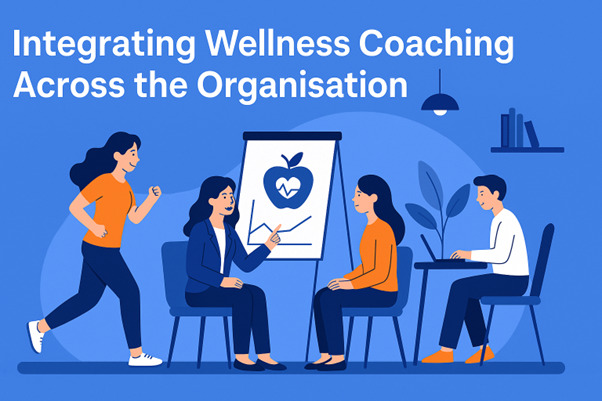
Integrating Wellness Coaching Across the Organisation

Integrating Wellness Coaching Across the Organisation

1. Train and Certify Internal Coaches

Organisations can cultivate a coaching culture by developing certified internal coaches. These individuals become trusted well-being ambassadors who support peers and model sustainable performance behaviours.

Accredited training ensures coaches operate ethically and effectively. The demand for qualified wellness coaches continues to rise globally, and wellness coaching programmes are helping organisations embed these competencies across departments.

2. Embed Coaching into well-being Programmes

For real impact, wellness coaching should not sit in isolation. It should be integrated into existing well-being frameworks, leadership development, and performance management.

Offer employees access to one-to-one or group coaching sessions. Incorporate well-being discussions into regular check-ins. Encourage leaders to use coaching conversations rather than performance policing. This normalises self-care and fosters accountability for well-being.

3. Measure Impact and Communicate Results

Wellness coaching delivers measurable outcomes when tracked effectively. Metrics such as employee engagement, turnover rates, stress levels, and absenteeism provide valuable insights.

Regular feedback loops demonstrate ROI and reinforce leadership commitment. As data accumulates, organisations can refine their well-being strategies, targeting areas where burnout risk remains high.

The Future of Wellness Coaching in the Workplace

Workplaces are evolving faster than ever. Hybrid and remote teams blur boundaries between work and rest, making burnout harder to detect. In this new environment, wellness coaching becomes not just beneficial but essential.

The future lies in systemic approaches — integrating individual well-being with team dynamics and organisational culture. Rather than treating symptoms, wellness coaching addresses root causes: workload design, communication norms, and leadership styles.

Forward-thinking organisations are already shifting from performance-first models to well-being-driven cultures. They recognise that sustainable success depends on human energy, not endless output.

Turning the Silent Exit into a Sustainable Stay

Burnout-driven resignations aren’t inevitable. They’re a signal — a call to create healthier, more supportive workplaces. Wellness coaching offers a proactive path forward, turning disengagement into empowerment.

By fostering awareness, resilience, and purpose, a wellness coach helps employees rediscover their motivation and commitment. More importantly, it reminds organisations that people aren’t replaceable resources — they’re their most valuable asset.

When well-being becomes strategy, not just sentiment, performance and retention follow naturally. The silent exit gives way to sustainable stay — where individuals thrive, teams perform, and organisations prosper.

Final Thoughts

The message is clear: burnout prevention is not a luxury; it’s a leadership responsibility. Investing in wellness coaching is investing in longevity — of both people and performance. 

A culture that values rest as much as results will always outperform one that glorifies exhaustion. Through skilled wellness coaching, organisations can shift from managing burnout to mastering balance — creating workplaces where success no longer comes at the cost of well-being.

How Wellness Coaching Helps Organisations Reduce Burnout-Driven Resignations Read More »